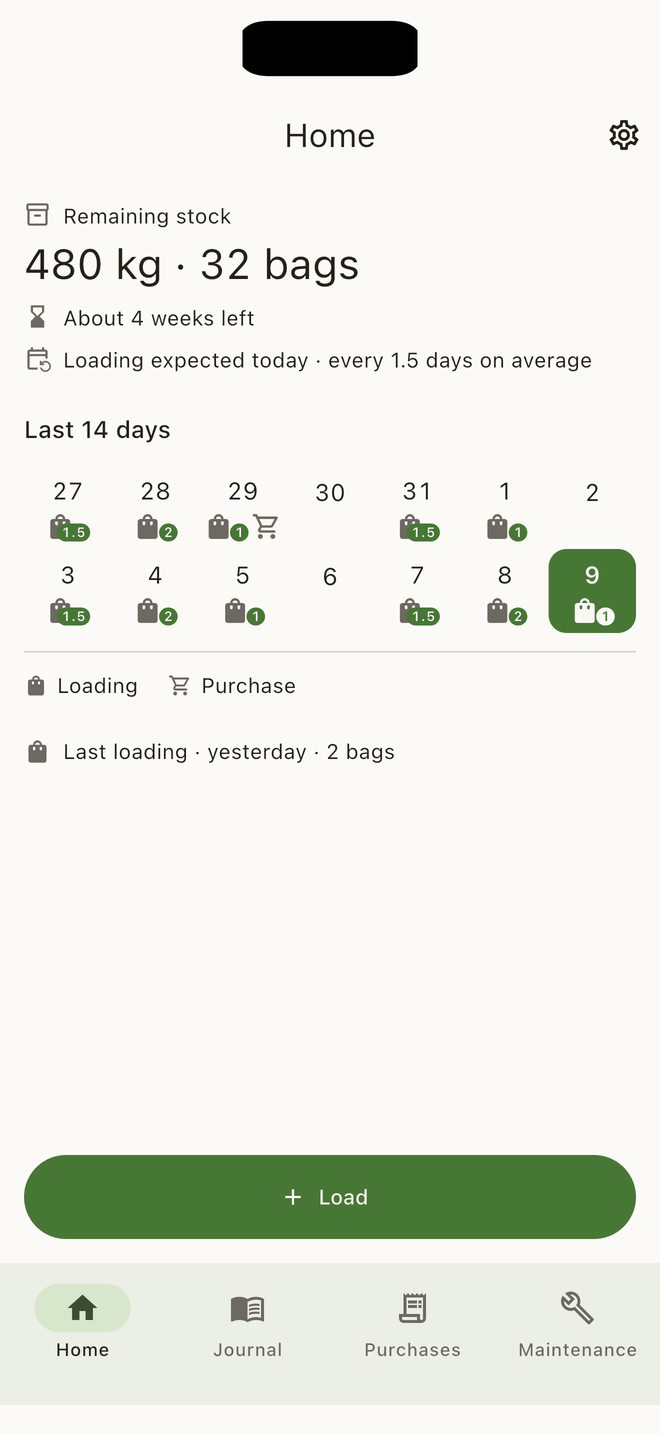
Work out what you need
Enter your stove’s output (it is on the rating plate or in the manual), how long it runs each day and how long your heating season lasts.
Estimate for one season
An estimate, not a measurement: it assumes ordinary-quality pellets and a recent stove. Your own consumption, counted bag by bag, will always be closer.
Where these figures come from
A kilo of pellets holds about 4.7 kWh of energy: ENplus A1 certification requires at least 4.6 kWh/kg[1]. A recent stove delivers 87 to 90% or more of it into the room, depending on its class under the French Flamme Verte label[2]; the sum uses 90%. An 8 kW stove running flat out would therefore burn close to 1.9 kg an hour, which manufacturers’ data sheets confirm, quoting 1.8 to 1.95 kg/h for stoves of that output[3].
But a stove hardly ever runs flat out: it modulates. On a medium setting, ten hours a day for six months, the same stove burns about 2,043 kg, or 136 bags. That is the sum the calculator above does. It is in line with La Maison Saint-Gobain’s estimate of about 2.2 tonnes (148 bags) for a well-insulated 100 m² house over a six-month heating season[4].
What makes consumption vary
- How well the home is insulated: with the same stove, a poorly insulated house needs noticeably more pellets, as the stove runs longer and harder.
- The temperature you set: each degree lower cuts heating consumption by roughly 7%, according to ADEME, the French energy agency[5].
- The climate and the winter itself: a cold January weighs more than a whole October.
- Pellet quality: damp or dusty pellets give less heat and foul the burner. Keep your bags dry, away from cold walls.
- Servicing: a clogged burn pot burns badly and uses more.
The most reliable method: count your own bags
No formula knows your house. The best estimate is still your past consumption: note each bag as you pour it in, and by the end of the winter you will know what you really need. During the season, last week’s bags multiplied by the weeks remaining give a fair idea of what is still to come, bearing in mind that the coldest months weigh more.
Our own experience: two winters in a notebook
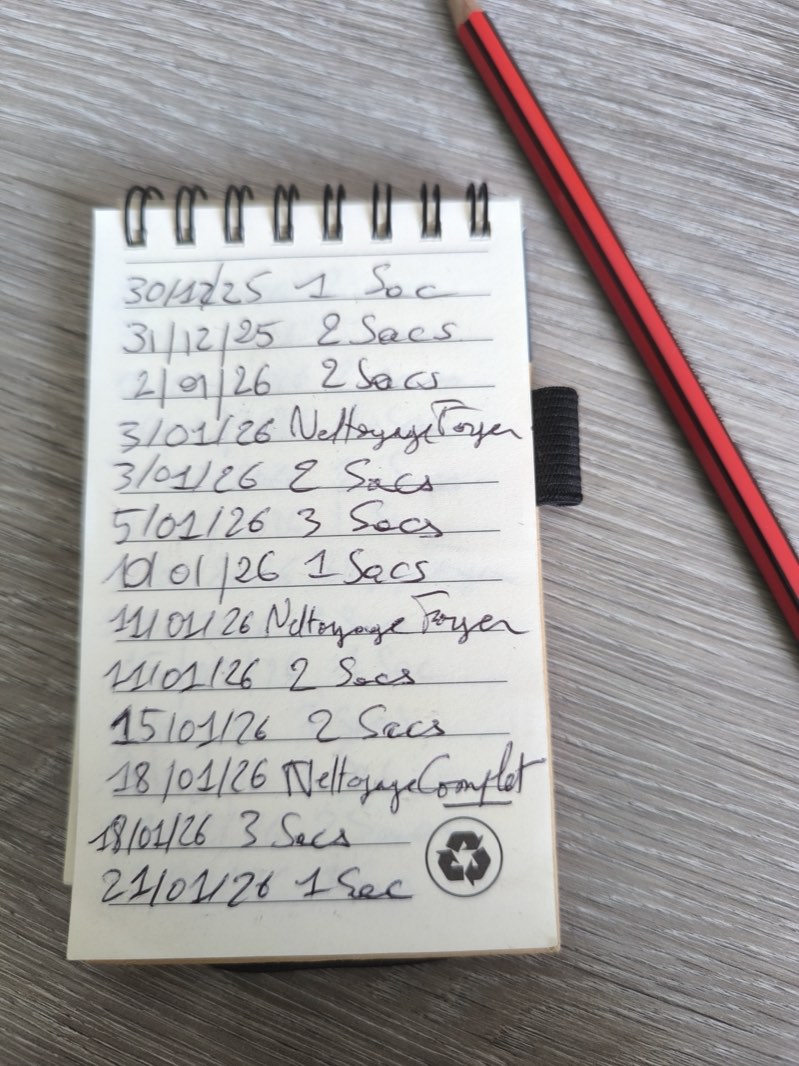
For two winters we wrote down every bag in a notebook next to the stove: a Rika Domo rated at 10 kW, with a 50 kg hopper, the main heating for a 150 m² house. The notebook was kept up to date; the total had never been worked out. Here it is.
| Winter | Bags | Weight | Cost (2025 price) |
|---|---|---|---|
| 2024-2025 | 78 | 1.2 t | €398 |
| 2025-2026 | 80 | 1.2 t | €408 |
Two winters within two bags of each other: about 80 bags, or 1.2 tonnes. January alone accounts for a quarter of the season, 20 bags both years; in the coldest spells, two bags go every three or four days. At €340 a tonne delivered, or €5.10 a bag, a winter comes to about €400.
That is less than the stove’s output would suggest, for three reasons: a timer only runs it during set time slots, it often idles at low output, and the furthest bedrooms get an electric top-up when the heat does not reach them. No average would have told us that; the notebook did.
How much to order, and when
- Start from last winter’s consumption, or the estimate above, and add a 10 to 15% margin for a colder winter.
- Compare offers per kilo, delivery included: the price of a bag varies with the supplier, the quantity ordered and the time of year.
- Only store what you can keep dry: a bag that has taken on moisture is a bag lost.
Sources
- ENplus, Handbuch, Teil 3: Anforderungen an die Pelletqualität (in German), version 3.0, August 2015, table 1: net calorific value ≥ 4.6 kWh/kg, moisture ≤ 10%.
- Que Choisir, Chauffage au bois : les nouvelles exigences de Flamme Verte (in French), 17 March 2015: pellet stoves, minimum efficiency of 87% at 6 stars, above 90% at 7 stars.
- Data sheets for 8 kW stoves: Seguin (0.76 to 1.95 kg/h),La Nordica Amika Evo (0.7 to 1.8 kg/h).
- La Maison Saint-Gobain, Consommation d’un poêle à granulés : calcul et estimations (in French).
- ADEME, quoted by Connaissance des Énergies, L’ADEME liste 37 astuces pour réduire vos factures d’énergie (in French), updated 29 November 2024.
The calculator applies: consumption (kg) = output (kW) × setting × hours × days ÷ (4.7 kWh/kg × 90%), with a setting of 40, 60 or 80% of rated output (40% roughly matches the reduced output in data sheets) and a ± 15% range.