Why I wanted a diary without calories
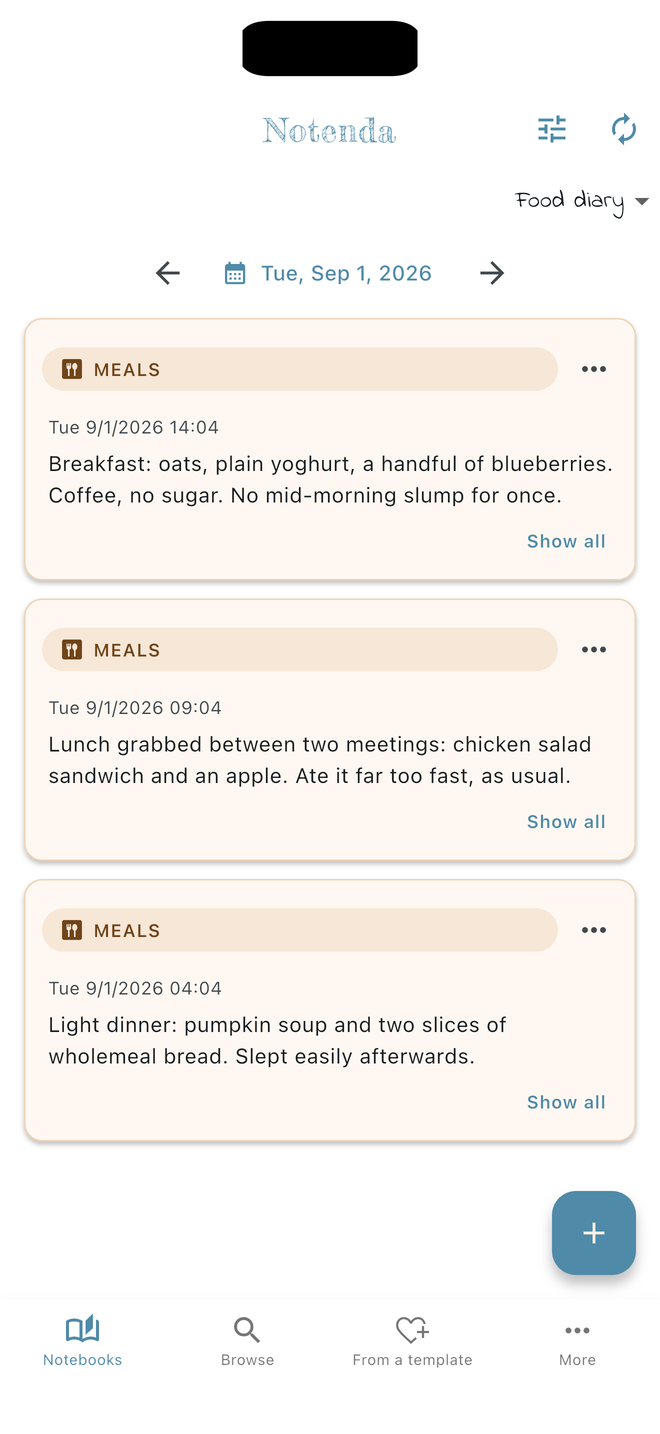
Notenda began as a food diary. I wanted something simple to write down what I ate. No calorie counting. No guilt-inducing advice. Just… writing it down. I could not find an app that did only that, so I built it.
Many food-tracking apps assume you need to count. But writing down and counting are not the same thing. You may want a record of your meals to know yourself better, for a medical appointment or simply out of curiosity, without turning every plate into a number.
What is worth writing down
The leaflet a British hospital gives patients with irritable bowel syndrome suggests a very simple table, day by day: breakfast, lunch, dinner, snacks and drinks, then symptoms[2]. You can add whatever seems useful:
- What you eat and drink, with a rough amount — in words, not grams: “a plateful”, “a bowl”.
- The time of each meal or snack.
- How you feel: hunger, tiredness, stress, calm.
- Any symptoms, and when they appear.
A food can cause symptoms straight away or up to 48 hours later, the leaflet points out, and it is by looking at meals over several days that patterns show[2]: a diary tells you more than a memory.
When a doctor asks for one
In France, for a food allergy assessment, the doctor asks in particular for a precise account of what you ate over a week and looks for the link between your symptoms and those foods; the French national health insurance also advises noting which foods seem to trigger symptoms[1]. A diary kept day by day makes that work simpler and more accurate.
One precaution the hospital leaflet also gives: do not cut out a food group on your own without speaking to a health professional[2]. The diary is for observing; conclusions are drawn with your doctor or a dietitian.
Counting, or just writing down?
Counting calories suits some people and not others. A study published in 2017 among 105 people treated for an eating disorder found that 74% had used a calorie-counting app, and that 73% of those users felt it had at least somewhat contributed to their disorder[3]. The authors stress that this retrospective, self-reported survey cannot establish cause and effect.
None of this makes counting dangerous for everyone. But if the numbers weigh on you, it is perfectly legitimate to keep a diary with none in it. And if your relationship with food worries you, talk to your doctor.
Keeping it up without effort
- Write it down at the time, or just after: by evening, the 4 pm snack is already forgotten.
- Keep the same format from one meal to the next: a ready-to-fill template saves time.
- A photo sometimes replaces a description.
- Read it back by day: habits show when you see the days side by side.
- Export it before an appointment, so you have nothing to recite from memory.
Sources
- Assurance Maladie (ameli.fr), Allergie alimentaire : la consultation médicale et les mesures au quotidien (in French), 18 September 2024.
- University Hospitals of Leicester NHS Trust, Keeping a food diary when you have symptoms of irritable bowel syndrome (IBS), reviewed February 2026.
- Levinson C. A., Fewell L., Brosof L. C., My Fitness Pal calorie tracker usage in the eating disorders, Eating Behaviors, vol. 27, 2017, pp. 14–16.